ARTICLE 19 strongly condemns the decision taken by the National Observatory of Communication/Observatoire National de la Communication (ONC), issued on 8 May 2026, to suspend nine international media outlets on grounds related to public order and ‘national stability’. This measure constitutes a serious violation of the right to freedom of expression and the public’s right to access independent and diverse sources of information.
On 8 May 2026, Niger’s ONC, which was established by the military authorities, ordered the immediate suspension of nine international media outlets: France 24, Radio France International, Agence France Presse, TV5 Monde, Jeune Afrique, Mediapart, LSI Africa, TF1 Info and Mediapart. The authorities justified the decision by alleging that the media outlets had repeatedly disseminated content likely to ‘jeopardise public order, national unity, social cohesion and the stability of state institutions’. The decision was made public on 9 May through the public media TV Sahel channel.
This measure takes place in a broader context of sustained restrictions on media freedom since the military seized power in July 2023. Since then, several foreign media outlets have been suspended, while journalists, both national and international, have faced arrests, detentions, and legal pressures.
‘The decision to suspend multiple media outlets in Niger is not an isolated measure, it is part of a broader and deeply concerning pattern of shrinking civic space and control over information and narratives on public interest matters, especially security. International human rights law and relevant African principles are clear: restrictions on expression must be exceptional, not the norm. When applied indiscriminately, as in this case, they not only fail the tests of necessity and proportionality, but entrench the climate of censorship and fear among media, journalists and advocates,’ said Alfred Nkuru Bulakali, Regional Director for ARTICLE 19 Senegal and West Africa.
‘The unequivocal message this sends is that those who don’t inform in a way the government likes will never be tolerated, in contravention of African principles on freedom of expression, which promote diverse discourse and information and pluralist media. The ONC must reverse this decision and the government must end its pattern of cracking down on media editorial independence and align with the applicable African standards.’
ARTICLE 19 has repeatedly stressed that restrictions on media freedom should be exceptional and narrowly tailored in line with African Union and international laws and standards. The blanket and immediate media suspension – applied without any transparency, due process or proportionality – violates the requirements under international law.
Context
Since the military coup of July 2023, which brought General Abdourahamane Tchiani to power, Niger has witnessed a progressive tightening of control over the media and civic space, marked by repeated restrictions targeting both international and national journalists.
In the immediate aftermath of the coup, authorities suspended major foreign broadcasters, including France 24 and Radio France Internationale (RFI), setting an early precedent for the use of media bans against outlets perceived as critical. This trend continued in December 2024, when the BBC was also suspended, further reducing access to independent international news sources.
Alongside these measures, journalists operating within Niger have faced arrests, prolonged detentions, and criminal charges, often linked to accusations such as ‘undermining national defence’ or ‘conspiracy against the authority of the state.’ International organisations, including the United Nations, have raised concerns over these practices, noting that multiple journalists have been detained in recent years, with some held for extended periods.
The legal environment has also evolved in a more restrictive direction. In 2024, authorities strengthened repression of speech by increasing sanctions for dissemination of information deemed likely to disturb public order, providing a broad and vague legal basis often used to justify actions against journalists and media actors.
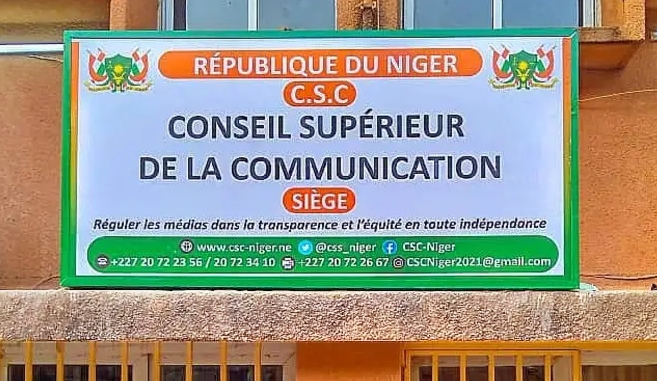
The military regime set up the ONC in 2025, replacing the regulatory body, the Conseil Supérieur de la Communication (CSC), which was initially set up according to the constitution. Authorities also suspended the Maison de la Presse, the country’s media associations umbrella body.
Niger’s crackdown on international media is part of a broader trend across the Sahel region. In Burkina Faso, since the military takeover in 2022, authorities have repeatedly suspended, banned or blocked several international media outlets including France 24, Radio France International, TV5 Monde, British Broadcasting Corporation (BBC) and others.
In Mali, la Chaine Info (LCI) and Télévision Française 1 (TF1) continue to face bans.
For more information, please contact:
ARTICLE 19 West Africa
+221 33 869 03 22 _ E: senegal.westafrica@article19.org
Maateuw Mbaye, Protection and Civic Space
+221 78 595 83 37_ E: maateuw.mbaye@article19.org